


FLYWING
BELL-204 ACE Scale RC Helicopter - Remote SAR
BELL-204 ACE Scale RC Helicopter - Remote SAR
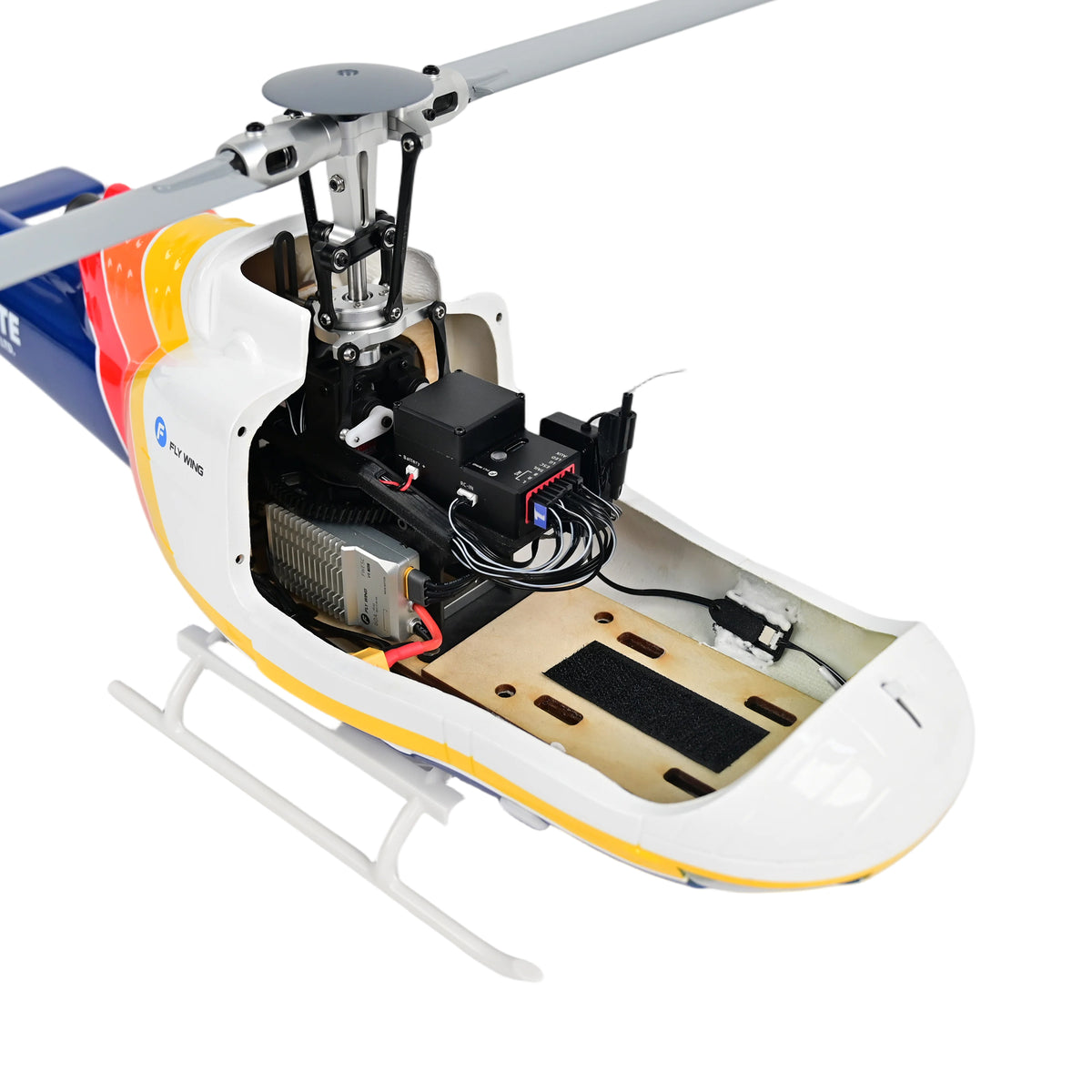
A classic BELL-204 in authentic scale, with a light two-blade flybarless rotor head, quick-release blades, five flight modes from GPS Hover to Manual, three Return-to-Home functions, and the FY-RC02 telemetry transmitter.
Regular price
$1,399.00 AUD
Regular price
Sale price
$1,399.00 AUD
Ready to Fly Transmitter, battery and charger included.
Quantity
Add-Ons
Couldn't load pickup availability


BELL-204 ACE
SCALE RC HELICOPTER

Authentic Design,Exquisite Details
Beyond LooksThoughtful Engineering

Flybarless (FBL) Rotor Head
This two-blade FBL rotor assembly delivers a light, agile flight feel. Its authentic scale design and exceptionally smooth handling create a more natural, lifelike flying experience.
Flybarless (FBL) Rotor Head
This two-blade FBL rotor assembly delivers a light, agile flight feel. Its authentic scale design and exceptionally smooth handling create a more natural, lifelike flying experience.

Optimized Quick-Release Blades
Designed for a two-blade rotor system, these blades feature a quick-release design for easy installation. Their optimized aerodynamic profile delivers efficient lift and responsive flight performance.
Optimized Quick-Release Blades
Designed for a two-blade rotor system, these blades feature a quick-release design for easy installation. Their optimized aerodynamic profile delivers efficient lift and responsive flight performance.

Quick-Release Rotor Holder
The upgraded quick-release mechanism makes rotor blade installation and removal simpler and faster, improving convenience during assembly, replacement, and routine maintenance.
Quick-Release Rotor Holder
The upgraded quick-release mechanism makes rotor blade installation and removal simpler and faster, improving convenience during assembly, replacement, and routine maintenance.
GPS Hover
The flight controller uses GPS positioning to help maintain the helicopter's position and attitude. When the sticks are released, the helicopter will hold its position in the air. This mode is recommended for beginners, providing an intuitive and effortless flying experience for everyone.

Freedom Mode
The flight controller provides a smoother flight profile by minimizing the braking force normally experienced in GPS Mode. It maintains hover capability while significantly allowing an open yet stable flying experience. Blending the safety of GPS and the fluid motion of ATT Mode, Freedom Mode allows a realistic flight experience. When the sticks are released during forward flight, the helicopter will coast at an almost level attitude and gradually come to a stop, instead of continuously drifting as it does in ATT Mode.

Attitude Mode
The helicopter is limited from excessive roll or pitch, making it impossible to inadvertently flip the helicopter. The flight controller continues to stabilize the helicopter and provides altitude-hold function, but does not provide position hold as you would experience while in GPS Mode. When the sticks are released, it can drift with wind and momentum.

6G Mode
Similar to ATT, the helicopter is limited from excessive roll or pitch, making it impossible to inadvertently flip the helicopter. The flight controller continues to stabilize the helicopter, while the pilot has direct control over the helicopter's movement and collective pitch. The pilot is responsible for maintaining the desired attitude, as it is not automatically maintained. Reducing collective too much can cause the helicopter to descend and impact the ground. 6G Mode provides an advanced level of control as you transition from GPS flight to manual flight.

Manual Mode
The flight controller provides essentially no automatic attitude stabilization. The pilot has direct control of the helicopter and must manage its attitude and flight dynamics manually.


Smart
ReturnSystem
With three Return-to-Home (RTH) functions, the BELL-204 ACE can assist the helicopter in returning to its home point when the relevant conditions are met (e.g., RC signal loss, low battery, or one-key return), adding an extra layer of confidence to every flight.
Three FlightSensitivities Mode

Flight speed, flight angle, and response speed are limited for easier control, ideal for beginners.

During normal flight, both the flight speed and maximum flight angle will increase.

Flight speed, flight angle, and response speed reach their maximum for experienced pilots.

Explore MoreNew Flight Experiences


Intelligent Coordinated Turns
Coordinated Turn automatically adds roll input based on flight conditions, allowing the helicopter to bank naturally through turns.
Intelligent Coordinated Turns
Coordinated Turn automatically adds roll input based on flight conditions, allowing the helicopter to bank naturally through turns.

Soft Takeoff & Landing
Soft Take-Off/Land optimizes throttle response for smoother transitions.
Soft Takeoff & Landing
Soft Take-Off/Land optimizes throttle response for smoother transitions.
Natural
FlightAuthentic
Scale
FY-RC02Transmitter with Telemetry
Five Main Information Views

Telemetry Info
Telemetry Info

Speed Gauge
Speed Gauge

Attitude Indicator
Attitude Indicator

Health Status
Health Status

Flight Logs
Flight Logs

A New ExperienceCommand at Your Fingertips
Live Telemetry

5-Language Voice Alerts

Long Runtime

One Transmitter
Multiple Models. Bind & Fly

On-Transmitter
Tuning Simplify Your Setup

Flight Log Replay

2.8" TFT Color Display

What's Included
-

-

-
 RTF Only
-
 RTF Only
-

-
 RTF Only


*Accessories marked RTF Only are included with the RTF version only.
The PairReady version includes the helicopter, rotor blades, and user manual.
Specs

- Model
- BELL-204
- Rotor System
- 2-BLADE
- Rotor Head
- DFC all-metal CNC 2-blade quick-release rotor head
- Main Blades
- NACA 8-H-12 flat-convex nylon quick-release blades
- Landing Gear
- Fixed skid landing gear
- Flight Controller
- H-ACE flight controller
- Positioning
- M10 GPS with barometric altitude hold
- Flight Modes
- GPS Hover, Freedom, Attitude, 6G, Manual
- Flight Sensitivity
- Soft, Standard, Sport
- Return to Home
- 3 triggers: RC signal loss, low battery, one-key return
- Flight Battery
- 4S 14.8V 5000mAh LiPo (RTF Only)
- Charger
- A4 40W balance charger (RTF Only)
- Transmitter
- FY-RC02 with telemetry, 2.8" TFT color screen, 5-language voice alerts, 5000mAh (up to 7 hours) (RTF Only)
Media


FAQ
Will the helicopter crash if it loses GPS signal?
No. If GPS signal is lost, the helicopter normally loses horizontal position hold, so it will not hover in place like it does in GPS mode, but it should still maintain basic attitude and altitude control.
Control will become more demanding and the helicopter may drift. Keep it within visual line of sight, avoid trees, buildings and people, and land in a safe open area.
Can ATT mode be used indoors?
ATT mode does not rely on GPS positioning. It uses sensors such as the gyroscope, accelerometer and barometer to help maintain attitude and altitude, so it can start without GPS.
However, indoor spaces are confined and full of obstacles, and the helicopter will not hold position like it does in GPS mode. Indoor flying is not recommended unless the pilot is experienced and has a safe, controlled area.
Is it normal for the helicopter to hover with a slight tilt?
Yes. A single-rotor helicopter may hover with a slight tilt because of main rotor torque and the side force generated by the tail rotor.
If the helicopter holds a stable hover without severe vibration or uncontrolled drift, a small tilt is usually normal and does not require adjustment.
Why does the helicopter shake strongly on the ground but become normal in the air?
This is often caused by ground resonance or poor grip on a hard, smooth surface such as wood flooring, concrete or stone.
- Take off from grass, soil or a non-slip mat where possible.
- Check that the main blade screws are tightened correctly.
- If shaking continues or becomes worse, stop flying and inspect the blades, blade grips, spindle shaft and landing gear.
What does a flashing red/yellow ACE flight controller light mean?
A flashing red/yellow light usually means the controller has not met the conditions for arming or starting. Common causes include low battery voltage, not being armed yet, or a compass/GPS warning.
- Confirm the flight battery is fully charged, preferably above 75%.
- Arm the helicopter first, then move the start switch only after the normal ready indication appears.
- Connect the ACE software and check voltage, GPS and compass status messages.
How do I properly inspect my helicopter before my first flight?
A thorough pre-flight inspection is crucial for safety. Please watch our detailed guide on how to inspect your helicopter to ensure everything is in perfect working order.
Is there a guide for installing the rotor blades?
Yes, proper blade installation is critical. You can find a step-by-step tutorial here: Rotor Blade Installation Tutorial.
My helicopter is shaking excessively during flight. What's wrong?
Shaking can be caused by a few factors. Our comprehensive video, Solutions for Helicopter Shaking, addresses common causes and solutions applicable to all models.
My helicopter suddenly fell from the sky, but I didn't crash it. Is it a quality issue?
We understand your concern. While it feels like a product issue, these incidents are almost always due to operational errors that can happen to any pilot. For example, accidentally switching to "3D Mode" or having a sleeve catch the "STOP" switch can cause a crash. We find that the most common cause is the "Return-To-Home" feature activating due to a low battery. Please review this video on the low battery feature. If parts were damaged, they are available for purchase in our store.
Who is responsible if an accident occurs during the use of a product?
The end user assumes full responsibility and all risks associated with the use of radio-controlled flight products. Flywing accepts no responsibility for injury, death, or damage arising from the use of any products purchased from us.
What is your policy on battery safety?
Customers are solely responsible for the safe use, charging, handling, storage, and disposal of Lithium Polymer (LiPo) and other batteries. We disclaim all liability for any damages or injuries related to battery use.
What should I do if the UH1-V4 wobbles or shakes in flight?
In-flight wobble or shaking is usually related to blade tightness, mechanical friction or parameter settings. Blades that are too tight are a common cause.
Check that the main blades can move smoothly, then inspect the blade grips, spindle shaft, linkages and servos. If the mechanics are normal, check the flight controller settings according to the manual.
Why is the helicopter unstable when flying near apartment buildings?
Tall buildings can block or reflect GNSS/GPS signals, reducing positioning accuracy. This may cause drift, unstable position hold or an inaccurate return point.
Fly in an open area away from buildings, trees, power lines and large metal structures.
How can I check whether the flying site has compass interference?
After powering on and before takeoff, carry the helicopter slowly around the flying area and watch the ACE controller light and software status.
If the light cannot stay in the normal green state, or the software reports a compass warning, move to a more open location away from metal objects and electromagnetic interference, then recalibrate according to the manual.
How do I enable manual 3D mode on ACE?
In the transmitter mode-channel settings, change the relevant mode value from 1000 to 1300. The lowest position of the mode switch can then be used as manual 3D mode.
3D mode requires advanced flying skill. Before enabling it, confirm that pitch, throttle, arming and stop switch settings are correct, and test only in an open area.
What transmitter values correspond to each ACE flight mode?
Common mode values are:
- ACE Scale: HOME 2000, GPS 1500, ATT 1000.
- ACE FW450L: GPS 2000, ATT 1500, Smart Acro 1000, 3D Acro 1300.
Values may vary by model or firmware version, so always confirm with the relevant manual and the ACE software display.
What should I do if ACE does not enter the selected flight mode?
Connect the ACE software and check whether the mode switch channel matches the mode shown in the software. When you move the transmitter switch, the corresponding mode in the software should change at the same time.
If it does not match, check the transmitter channel assignment, endpoint values, mixes and receiver output mode.
Will it affect the controller if I install the blades after GPS lock?
Usually no. The important point is not to move the helicopter while the controller is performing self-check, such as during alternating red/blue flashing.
After self-check is complete, the canopy or blades may be installed following safe procedures. Before installing blades, make sure the motor cannot start unexpectedly and the stop switch is in the safe position.
Why does the helicopter wobble or circle while hovering?
Wobbling or circling in hover may be related to compass calibration, mechanical friction or rotor head components.
- Recalibrate the compass in an open area first.
- Check whether swashplate linkages and ball joints are binding.
- Inspect blade grip bearings, the spindle shaft and servos for smooth movement.
If the problem continues, stop flying and complete a mechanical inspection before testing again.
What should I check if an ACE helicopter still shakes in flight after blade tightness has been ruled out?
If blade tightness is correct, check swashplate gain, the spindle shaft, dampers and overall mechanical vibration.
You may reduce swashplate gain slightly, then confirm that the rotor head, blade grips, linkages and servos are not worn, bent or binding.
Why does the helicopter rise briefly after I stop the motor?
If the pitch stick is released or allowed to spring back during motor stop, the helicopter may briefly climb before descending.
Follow the stop procedure in the manual and keep steady control of the pitch stick while the motor is stopping.
What can cause a helicopter to spin suddenly after takeoff?
If the tail rotor touches the ground or stops working during takeoff, the helicopter may spin suddenly. A common cause is pulling back on the stick during lift-off, causing the tail to dip and the tail rotor to strike the ground.
Keep the helicopter level during takeoff, avoid pulling back, and use a flat, open takeoff area.
Is left drift normal after switching from GPS mode to ATT mode?
Some drift is normal. GPS mode uses satellite positioning to hold position, while ATT mode does not provide horizontal position lock. The helicopter can drift due to inertia, wind and its own attitude.
After switching to ATT mode, be ready to manually correct position and practice in an open area.
Why does the helicopter oscillate up and down during high-speed forward flight in ATT mode?
During high-speed forward flight, aerodynamic drag from the fuselage and body shell can push the nose down. Repeated correction may create an up-and-down oscillation sometimes called porpoising.
Reducing forward speed usually reduces or removes the behavior. Avoid extended high-speed flight at maximum pitch angle in ATT mode.
How can I adjust a scale helicopter that keeps drifting left in ATT mode?
If the scale helicopter continuously drifts left in ATT mode, connect the H-ACE software, open the main rotor settings, and slightly increase the left servo parameter, for example by 10 to 20.
Make only small changes at a time and perform short test flights in an open area.
If I take off in ATT mode, can I switch to GPS mode in the air?
After power-on, the helicopter starts searching for satellites regardless of the selected mode. If GPS positioning is completed in the air, you can switch to GPS mode; if positioning has not completed, GPS position flight will not work correctly.
It is recommended to wait for GPS lock on the ground before takeoff so return-to-home can record a more reliable takeoff point.
How should I troubleshoot GPS that has stopped working normally?
First move away from magnets, signal towers, cables, large metal objects and other sources of electromagnetic interference, then power on again in an open outdoor area.
- Connect the PC software and check for warnings.
- Check the GPS Star and GPS HDOP values.
- Wait 5 to 10 minutes for GPS search to complete.
- If GPS HDOP is higher than 1.0, signal quality is usually poor. Test in another location.